
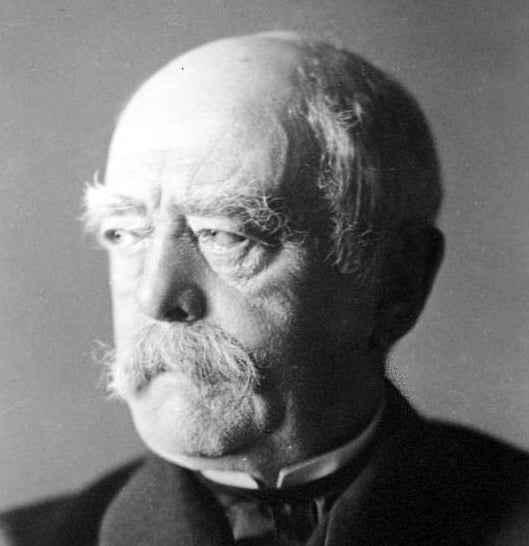
Otto von Bismarck was a Prussian statesman and politician who is widely regarded as the founder of the German Empire. Bismarck was born on April 1, 1815, in Schönhausen, a small town in the Prussian province of Saxony. He was the son of a wealthy landowner and belonged to a family of aristocratic landowners who had long held important positions in the Prussian government.
Bismarck received a thorough education in law and politics, and he quickly rose through the ranks of the Prussian government. In 1862, he was appointed prime minister of Prussia by King Wilhelm I, and he set about implementing a series of sweeping reforms that would transform the country and lay the groundwork for the German Empire.
Bismarck was a master of Realpolitik, a political philosophy that prioritizes practical considerations over moral or ideological concerns. He believed that the key to Prussian dominance lay in the unification of the German states, and he worked tirelessly to achieve this goal.
In 1864, Bismarck engineered a war with Denmark that resulted in the acquisition of the provinces of Schleswig and Holstein. Two years later, he provoked a war with Austria, which resulted in a resounding Prussian victory and the annexation of several additional territories.
Bismarck's crowning achievement, however, came in 1871, when he successfully united the German states into a single nation. The new German Empire was ruled by Wilhelm I, with Bismarck serving as the first chancellor.
Bismarck's legacy as a statesman is complex and contested. While he is widely regarded as a genius in the art of Realpolitik, his methods were often ruthless and his policies were controversial. Nevertheless, his impact on German history cannot be overstated, and his influence can still be felt today.