
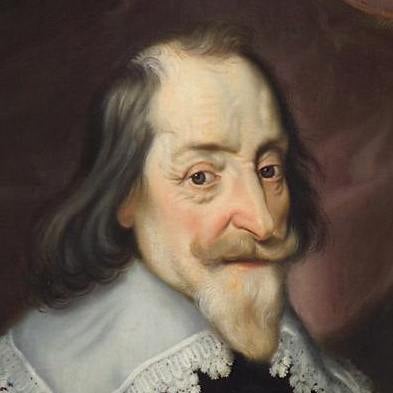
Maximilian I, Prince-Elector of Bavaria, was born in 1573 in Munich, Germany. He was the eldest son of William V, Duke of Bavaria, and his wife, Renata of Lorraine.
Maximilian I was a member of the House of Wittelsbach, a dynasty that ruled over Bavaria for several centuries. He received a comprehensive education in languages, philosophy, and the arts, which helped him become a patron of the arts and a knowledgeable ruler.
In 1597, Maximilian I succeeded his father as Duke of Bavaria. He proved to be an able ruler, strengthening the position of his family in Bavaria and the Holy Roman Empire. He expanded the economy and the administration of the state and sponsored the arts, architecture, and music. His court in Munich became a center of culture and learning.
Maximilian I was also a devout Catholic and a staunch defender of the Counter-Reformation. He fought against the spread of Protestantism in Bavaria and supported the Catholic League in the Thirty Years' War. He was instrumental in the Catholic victory at the Battle of White Mountain in 1620, which helped secure the Habsburgs' control over Bohemia.
Maximilian I died in 1651 at the age of 78. He was succeeded by his son Ferdinand Maria, who continued his father's policies and legacy.