
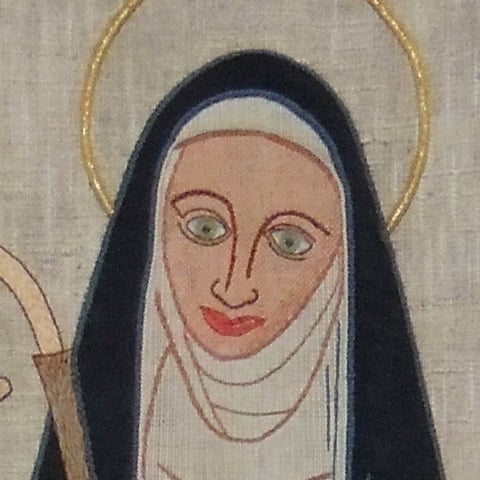
Hildegard von Bingen was a German Benedictine abbess, mystic, composer, philosopher, and polymath who lived during the 12th century. She is best known for her theological, botanical, and medicinal writings, as well as her visionary experiences and musical compositions. As a prominent and influential figure in the medieval church, her works span various disciplines, and her life and teachings provide valuable insights into the religious, cultural, and intellectual climate of 12th-century Europe.
Hildegard was born into a noble family in Bermersheim, near present-day Alzey in western Germany. From a young age, she experienced visions, which she later described as the reflection of the Living Light. At the age of eight, she was placed under the care of Jutta von Sponheim, who lived near the Benedictine Abbey of Disibodenberg. Under Jutta's guidance, Hildegard received a religious education and learned Latin, the Psalms, and the tenets of the Benedictine Rule.
When Jutta died in 1136, Hildegard was elected as the magistra, or head, of the community of nuns that had formed around Jutta's anchorage. In 1147, she received permission from the Abbot Kuno of Disibodenberg to establish a new monastery for her community at Mount St. Rupert near Bingen. In 1165, she founded a second monastery at Eibingen, across the Rhine River from Rupertsberg.
Hildegard was a prolific writer, and her works encompass theology, natural science, medicine, and music. Some of her most important writings include:
Know the Ways, completed in 115. This work contains descriptions of Hildegard's visions and their theological interpretations. The text is accompanied by illuminations that visually represent the visions, making it a significant work of medieval art and theology.
She also wrote the Book of Life's Merits in 1163. This work is a visionary treatise that explores the virtues and vices of the human soul, as well as the consequences of human actions in the afterlife.
Hildegard is also known for her musical compositions, which include hymns, antiphons, and sequences. Her music is characterized by its soaring melodies and striking use of harmony, reflecting the mystical nature of her visionary experiences. Her most famous musical work is the Ordo Virtutum, a morality play with music that explores the struggle between the human soul and the forces of virtue and vice.
In 2012 Pope Benedict XVI named her a Doctor of the Church for her perennially relevant and an authentic teachings of theology, and as a profound scholar of natural science and music.