
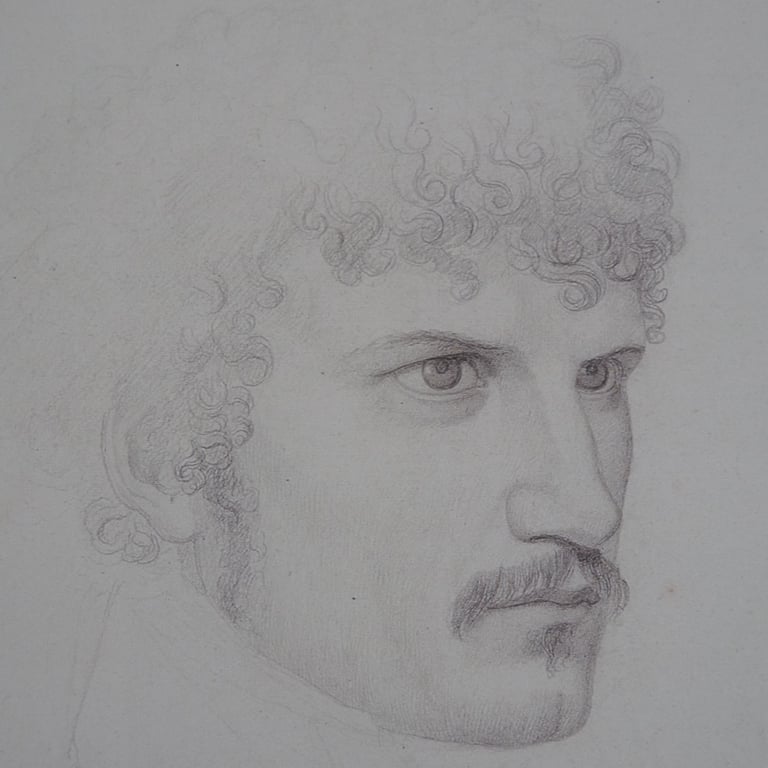
Johann Nepomuk Haller, born March 1, 1792 in Innsbruck, was an Austrian sculptor who worked primarily on commissions from the Bavarian royal family. Haller came from a poor family. His education began with an apprenticeship in woodcarving in Imst, then in 1811 he attended the art academy in Munich.
Haller succeeded in gaining the favor of Crown Prince Ludwig and, subsequently, King Max Joseph. Thus, in 1817 he was commissioned to execute the colossal statues for the niches on the front side and in 1818 the statues in the pediment of the Glyptothek in Munich. At the expense of the Bavarian royal family, Haller worked in Rome from 1819. There he worked in the circle of German Romans around Joseph Anton Koch for about four years. Illness forced him to return to Munich in 1823, where he died in 1826. Johann Nepomuk Haller died at the age of 34.
Commissioned by Ludwig I, Haller created the models for statues of Hephestus, Prometheus, Daedalus, Pheidias, Pericles, and Hadrian for the niches in the front of the Glyptothek. Haller's work is the bas-relief in the Hall of the Gods in the Glyptothek, depicting the victory of Jupiter over the giants. He also made the models of three figures for the pediment of the Glyptothek. However, the figures were altered when they were executed in marble.
In 1818 Haller made a fountain for Nymphenburg Park based on a design by Peter Simon Lamine. The sandstone figure Child with Dolphin depicts a boy riding a dolphin; the animal is sculpted in the contemporary style of a fish-like monster. Haller also modeled various portrait busts, including those of Joseph von Fraunhofer and Leo von Klenze. Also by him is the portrait bust of William III Orange in the Walhalla near Regensburg.
Haller died July 23, 1826 in Munich.