
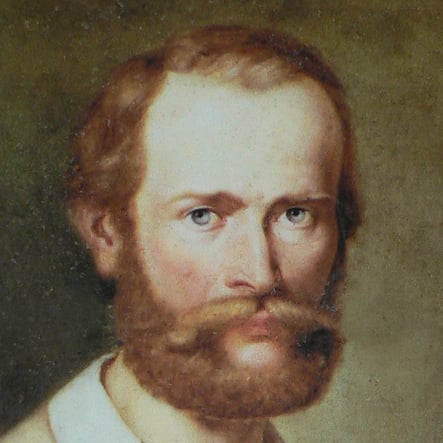
Ernst von Bandel born in 1800 in Ansbach to Georg Carl Friedrich Ritter von Bandel and his wife Johanna, was a German sculptor and architect. Raised during a period of political turmoil, he developed a strong patriotic spirit.
In 1814, he started studying art in Nürnberg, and by 1816, he was studying at the Academy of Fine Arts in Munich. Financial difficulties after his father's death nearly ended his artistic pursuits, but a scholarship from the Bavarian King Maximilian I helped him to continue.
Rejecting an assistantship with the architect Leo von Klenze in 1820 due to style disagreements, Bandel continued his career independently. With the financial backing of King Maximilian I, he worked in Italy from 1825-1827.
Returning to Munich in 1827, he married Karolina von Kohlhagen, with whom he had seven children, including the later sculptor Heinrich von Bandel. He worked at the Munich Glyptothek under Christian Daniel Rauch and served on the board of the Munich Kunstverein.
Bandel moved to Berlin in 1834, joining an artistic circle, and then to Hanover, where he decorated the Residenzschloss. From 1837 to 1846, he lived in Detmold, where he oversaw the construction of the Hermann Monument dedicated to Cheruscan prince Arminius.
Although he experienced financial hardships and public disinterest, Bandel continued his efforts to complete the Hermann Monument. His commitment saw renewed interest after the Franco-Prussian War, and the monument was inaugurated in 1875, attended by German Emperor Wilhelm I.
Suffering from kidney disease, Bandel was invited by Emperor Wilhelm I for a recuperative stay in Italy. He died in 1876 during his return journey and was buried in Hanover.