
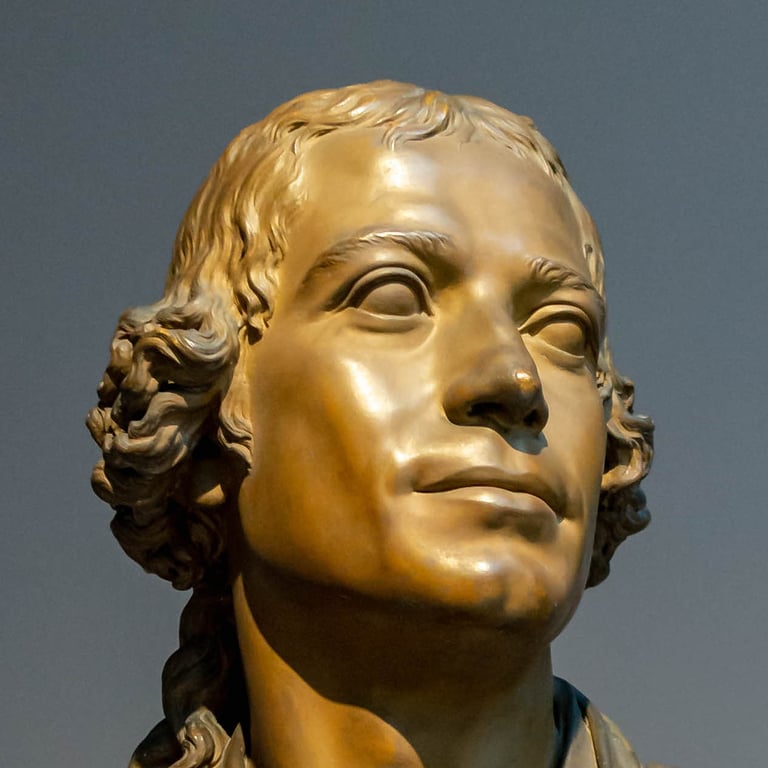
Johann Heinrich Dannecker, born in Württemberg, was a German sculptor known for his classicist style. The son of a groom and coachman serving the Duke of Württemberg, Dannecker was admitted to the "Military Plant School" at Solitude near Stuttgart in 1771. He began his career as a ballet dancer, then became a sculptor's apprentice.
Upon completing his studies at the ducal institute, which was transformed into the Hohe Karlsschule, Dannecker and his fellow student Philipp Jakob Scheffauer were appointed as court sculptors. A ducal scholarship enabled them to study in Paris and Rome, broadening their artistic horizons and inspiring them with encounters with such artists as Antonio Canova and Alexander Trippel.
After his return to Stuttgart in 1790, he became professor at the Hohe Karlsschule, and continued his teaching privately after the school's abolition in 1794. He later directed the K. Kunstschule, a newly established art school in Stuttgart.
Dannecker’s marriage to Heinrike Rapp, a merchant's daughter, afforded him a comfortable lifestyle, integrating him into Stuttgart's bourgeois society. His home, referred to as the Danneckerei, served as a residence, studio, art school, and museum, becoming a cultural hub of Stuttgart.
Dannecker's major works include the well-known busts of Schiller and his own self-portrait. His masterpiece, "Ariadne on the Panther," drew international attention in the Bethmann Museum, the first public museum in Frankfurt.
Dannecker also contributed to the Württemberg burial chapel, where colossal marble statues of the four evangelists, including his own representation of St. Johannes, grace the wall niches. His work remains part of Swabian classicism and marks him as an influential figure in the history of sculpture.