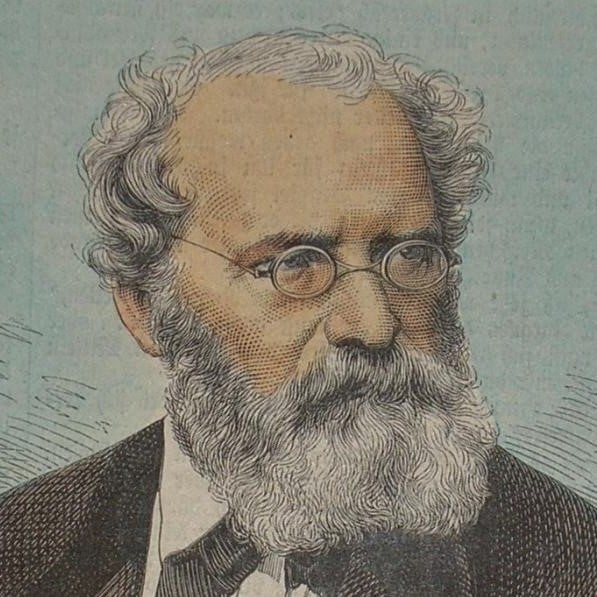
Ferdinand Miller was a noted Bavarian sculptor and ore caster, born in 1813, in Fürstenfeldbruck. He was instrumental in creating numerous monuments, including the monumental "Bavaria" in Munich while serving as the inspector of the Royal Ore Foundry. He co-founded the Bavarian Arts and Crafts Association and contributed to politics as a member of the Bavarian Parliament from 1869 and the German Reichstag from 1874.
Miller hailed from an Upper Bavarian family. His marriage to Anna Pösl in 1840 resulted in 14 children, some of whom pursued notable careers in arts, engineering, and chemistry.
Miller started his career as an unskilled labourer in the Royal Ore Foundry, working under his uncle, after which he was given the opportunity to attend the Royal Academy of Fine Arts in Munich and the Academy of Arts in Paris.
During his studies in Paris, he met Alexander von Humboldt, who informed him about King Ludwig I's project to cast a larger-than-life figure, "Bavaria". He returned to Munich, succeeding his uncle as the First Inspector of the Royal Arch Foundry, and embarked on the "Bavaria" project. The monumental piece took him eight years to create, using over 87,000 kg of ore.
Miller's works achieved worldwide recognition following his success at the 1st World's Fair in London in 1851, where he won the first prize. This exposure led to numerous commissions from around the globe, including significant works in America, like the gates for the Capitol in Washington, D.C., an equestrian statue in Columbia, and a 22-foot-high equestrian model of George Washington.