
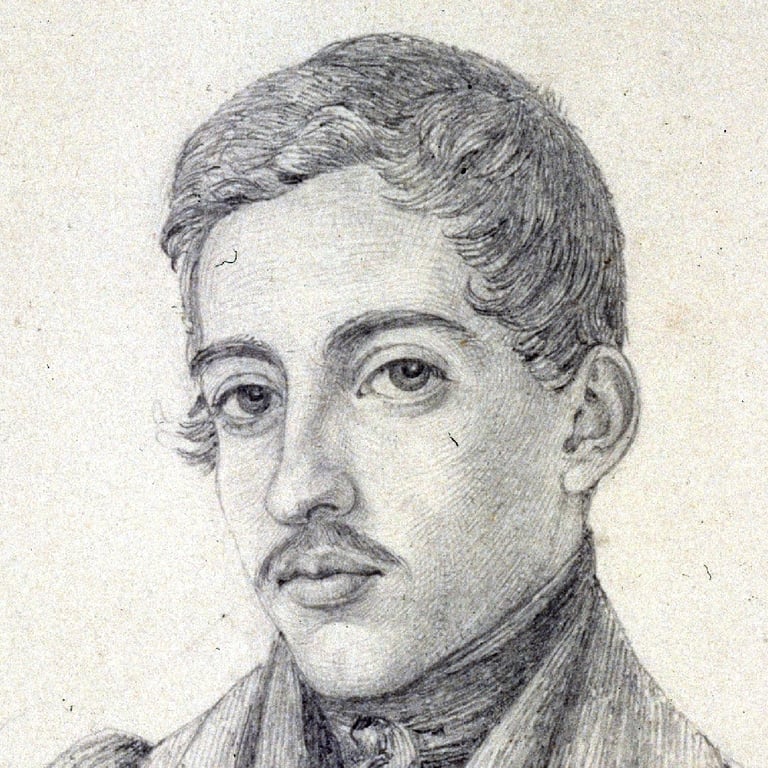
Emil Wolff, born in 1802 in Berlin, was a noted German sculptor recognized for his contributions to the classical genre of sculpture, which resembled the style of Bertel Thorwaldsen. Wolff's artistic journey began in 1815 when he started his studies at the Academy of Arts in Berlin. His education continued under the guidance of his uncle, Johann Gottfried Schadow, from 1818.
In 1821, Wolff's exceptional talent was acknowledged when he received an academic award for a relief he had crafted. This honour granted him the opportunity to travel to Rome in 1822, a city that would remain his home for the rest of his life. Despite his relocation, Wolff retained strong ties to his homeland of Germany, significantly aiding in the acquisition of numerous art pieces for the Prussian royal collection from Rome.
Wolff also found success with his mythological depictions. Some of his notable works in this genre include the 1825 relief "Midas as Judge", the marble relief of Charitas, and the group of Hebe and Ganymede.
He produced several important public works, such as "Victoria Instructing the Youth in History", displayed on the Palace Bridge in Berlin, and "Jephtha and his Daughter". His later creations, like "Judith", currently housed in the Berlin National Gallery, are also noteworthy.
One of his significant pieces, a sculpture called "Najade", was procured by King Frederick William IV in 1854.