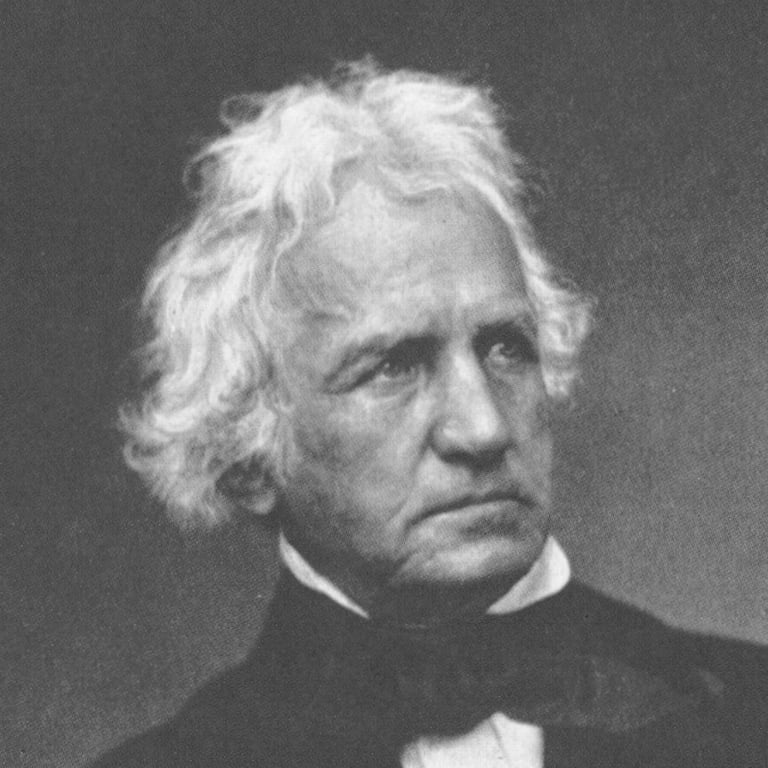
Christian Daniel Rauch was born in 1777 Arolsen, in the Principality of Waldeck within the Holy Roman Empire. His father served at the court of Prince Frederick II of Hesse, and in 1790, Rauch was apprenticed to Friedrich Valentin, the court sculptor of Arolsen. After the deaths of his father in 1796 and his older brother in 1797, he moved to Berlin, where he became a groom in the king's household. Although he temporarily abandoned sculpture, his new position allowed him to refine his skills in his spare time. He then began studying under the direction of Johann Gottfried Schadow.
In 1802, Rauch exhibited his sculpture "Sleeping Endymion." Queen Louisa of Prussia, who discovered him modelling her features in wax, sent him to study at the Prussian Academy of Art. Later, Count Sandrecky sponsored his education in Rome, where he received support and friendship from Wilhelm von Humboldt, Antonio Canova, and Bertel Thorvaldsen. During this period, Rauch created notable works, including a life-size marble bust of Queen Louise and busts of poet Zacharias Werner, Count Wengersky, and painter Raphael Mengs. He also produced bas-reliefs such as "Hippolytus and Phaedra," "Mars and Venus wounded by Diomede," and a "Child praying."
In 1811, Rauch was commissioned to create a monument for Queen Louisa of Prussia. The statue, portraying the queen in a sleeping pose, was placed in a mausoleum at Charlottenburg and brought him great fame and recognition across Europe.
By 1824, Rauch had created 70 marble busts, including 20 of colossal size. His colossal bronze statues of Blücher stood at 4 meters tall, and he was also responsible for the majority of the 12 iron statues comprising the National Monument for the Liberation Wars on the Kreuzberg near Berlin. One of his notable works, the group sculpture "Faith, Hope, and Charity," was presented to his hometown of Arolsen.
In 1830, Rauch began working alongside architect Karl Friedrich Schinkel on the models for a colossal equestrian monument in Berlin to honor King Frederick II. This work was inaugurated in May 1851 and is regarded as one of the masterpieces of modern sculpture, representing the pinnacle of Rauch's career as a portrait and historic sculptor.